
img3-alt

CI/CD PIPELINES

Optimize Your Development Cycle with CI/CD Pipelines

Combine your expertise with the power of Continuous Integration and Continuous Deployment on award-winning Contabo servers. Create efficient software delivery solutions without breaking the bank.

main-ci-cd

Build your ideal CI/CD Pipeline on Contabo servers

We empower developers who know what they need with the tools to create their ideal CI/CD pipeline. Take full control of automation to improve product quality and streamline update rollouts. Use a recommended option below, or build your own custom solution.
Icon for VDS CLOUD VPS 4

Development & Staging

€5.50
4
40 / month


Allocate as many separate development and staging environments as you need on cost-effective VPS configurations. Prioritize speed with NVMe storage for optimal performance.

Icon for VDS CLOUD VPS 6

Monitoring & Logging

€7.50
6
00 / month


Set up dedicated VPS instances with balanced CPU and RAM for monitoring CI/CD pipeline health and performance. Use centralized management tools for faster troubleshooting.

Icon for VDS CLOUD VPS 8

Repository Node

€14.00
11
20 / month


Deploy a virtual machine as your central repository and container registry, using GitLab or similar. Use a VPS with more CPU power and extra storage to meet your repository's needs.

Icon for VDS CLOUD VPS PLUS 12

CI/CD Runners

€59.00
47
20 / month


Utilize CPU-optimized VPS instances for running basic CI/CD tasks. These runners are essential for automated testing, app development, and efficient deployment processes.

We're Right Where You Need Us
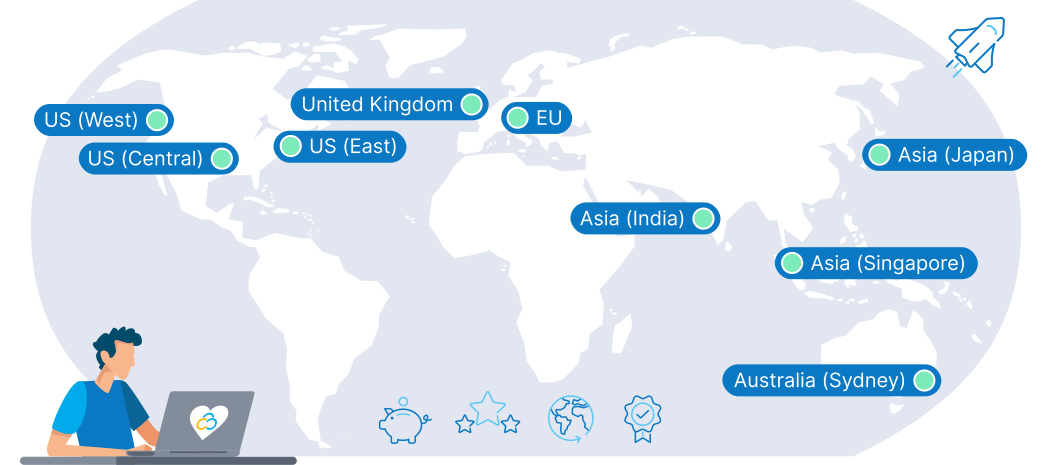
Choose the optimal location for your virtualization needs. Ensure low latency for your applications and users, seamless performance across distributed environments, and cost-efficiency that fits any budget.
Map Location en

CI/CD Pipeline Basics

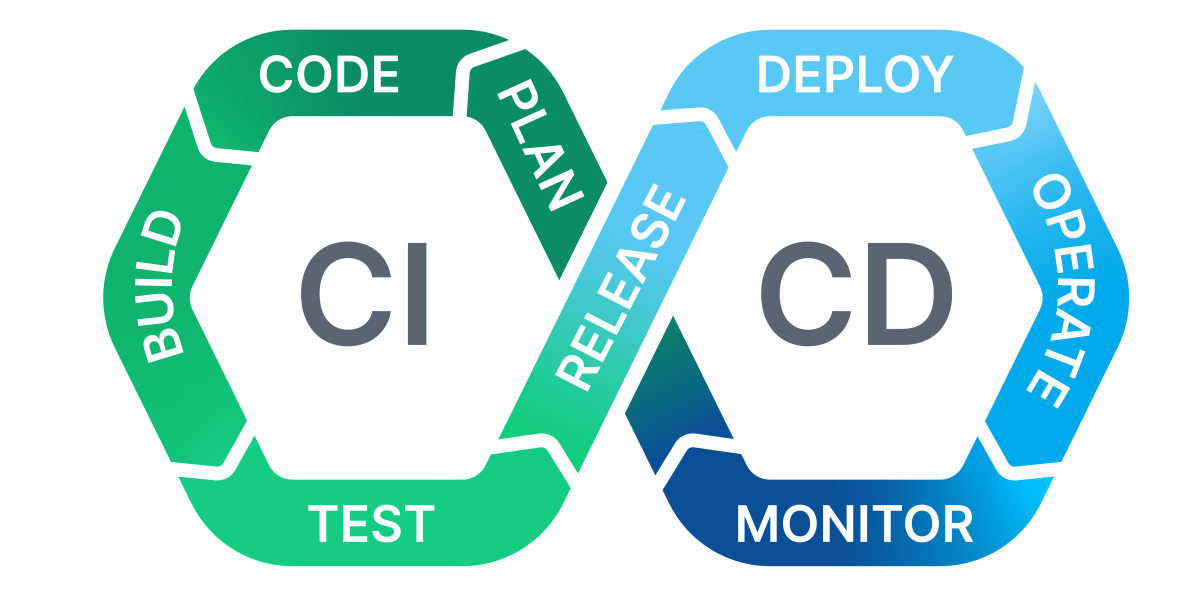
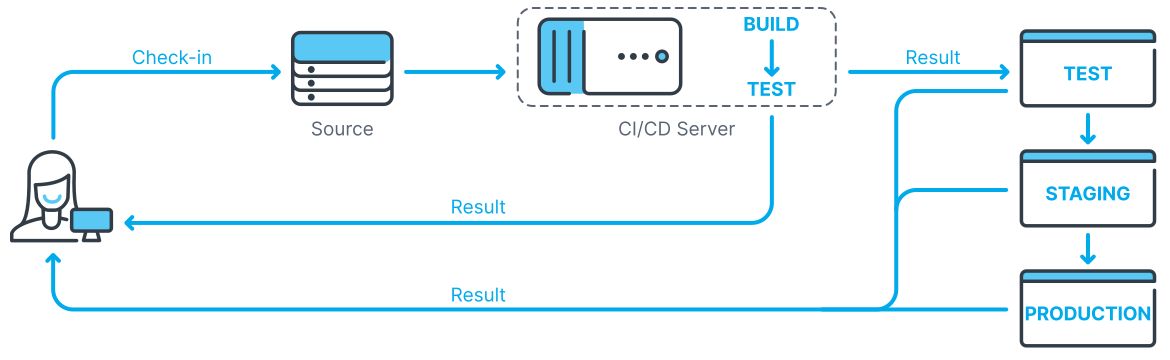
A CI/CD pipeline is a series of automated processes that enable developers to reliably and efficiently compile, package, and test their code before deploying it to production.


CI (Continuous Integration) refers to the practice of frequently integrating code changes into a shared repository, where automated builds and tests are run.


CD (Continuous Deployment or Continuous Delivery) automates the delivery of code changes after the build phase, either directly to production environments (Continuous Deployment) or to staging environments for further validation (Continuous Delivery).
ci-cd_explainer

Why Deploy Your CI/CD Pipeline on the Contabo Cloud?
Enhance your DevOps processes in several key areas using our cloud-based tools.
icon_accessibility

Accessibility


Cloud-based CI/CD pipelines offer unparalleled accessibility, enabling remote teams to collaborate seamlessly. This allows developers to push changes, monitor builds, and deploy applications from anywhere, ensuring continuous productivity.

Icon pricing

Cost Efficiency


Leveraging cloud infrastructure for CI/CD eliminates the need for heavy upfront investments in hardware. This scalable, flexible model allows for cost-effective rental of high-end resources, adjusting to demand and reducing overall expenses.

Icon Quick alt

Speed & Agility


Cloud platforms offer preconfigured environments that expedite CI/CD setup, enabling quicker deployment cycles. This agility shortens the time from code commit to production, accelerating product updates and feature releases.

Icon Security alt

Enhanced Security


Cloud-based CI/CD pipelines on Contabo servers come with  always-on DDoS protection  to keep your system safe. For additional protection for your code base, it's easy to install the custom security features of your choice.

Typical Tools and Setups for your CI/CD Pipeline

Leverage a wide array of CI/CD tools and setups to automate your development and deployment processes. Enhance efficiency and reliability at all stages of the pipeline.
Icon Windows
Windows
logo_small_linux
Linux
logo_small_git
Git
logo_small_subversion
Subversion (SVN)
logo_small_jenkins
Jenkins
logo_small_gitlab
GitLab CI/CD
logo_small_circleci
CircleCI
logo_small_circleci
Travis CI
logo_small_selenium
Selenium
logo_small_cypress
Cypress
vps-page-tab-panel-docker
Docker
logo_small_kubernetes
Kubernetes
logo_small_ansible
Ansible
logo grafana
Grafana
logo-Prometheus
Prometheus

Which Contabo Services Enhance Your CI/CD Pipeline?

Custom CI/CD pipelines benefit from focused Contabo services. Take advantage of APIs & CLI for integration and automation, Cloud-init images for rapid setup, private networking for security, and scalable Object Storage for efficient data management.
icon_api

APIs & CLI


Enable seamless automation and management of infrastructure via robust APIs and CLI tools, facilitating direct CI/CD tool integration for efficient workflows.

icon_custom-images

Custom Cloud-init Images


Utilize custom OS images with pre-installed software, alongside Cloud-init for automated initialization, ensuring rapid readiness of CI/CD environments.

Icon Private Network alt

Private Networking


Secure CI/CD operations within private networks, offering a safeguarded environment for pipeline execution away from public internet threats.

Trusted by Thousands Worldwide

190
Countries Served
275,000+
Customers Worldwide
500,000+
Servers Running
23 Years
In business

See What Other CI/CD Pipeline Customers Are Saying

Frequently Asked Questions about CI/CD Pipelines

FAQs | More information on configuring your CI/CD pipeline on contabo servers.
What are CI/CD pipeline best practices?
  1. Organization of Total Code
    Best practices include maintaining a clean and organized codebase with modular architecture to ease integration and testing. Using version control systems, like Git, helps manage changes efficiently, ensuring code integrity and facilitating collaboration.
  2. Use of Quality Gates
    Implementing quality gates at key stages ensures that code meets predefined quality criteria before advancing. This includes successful completion of automated tests, adherence to coding standards, and passing security audits, which are crucial for maintaining high-quality code throughout the development lifecycle.
  3. Branch Strategy
    Employing a well-defined branch strategy, such as GitFlow or trunk-based development, helps manage feature development, bug fixes, and releases systematically. This strategy supports parallel development while minimizing code integration issues, making the CI/CD process more efficient.
  4. Use of Staging Environments
    Utilizing staging environments that closely replicate production settings allows teams to identify and address deployment and environment-specific issues early. This step is crucial for catching bugs that may not be evident in development or testing environments, thereby reducing deployment risks.
  5. Ability to Roll-back
    Ensuring your CI/CD pipeline includes mechanisms for quick rollback in case of deployment failure is vital for minimizing downtime and preserving user experience. Automated rollback procedures enable rapid response to issues post-deployment, maintaining service stability.
  6. Vulnerability Scanning
    Integrating continuous security practices, such as regular vulnerability scanning and static code analysis, into the CI/CD pipeline helps identify and mitigate security risks early. Proactive security measures are essential for developing secure applications in today’s threat landscape.
  7. Orchestration
    Leveraging orchestration tools, like Kubernetes, helps manage complex deployments and microservices architectures efficiently. Orchestration automates the deployment, scaling, and management of containerized applications, enhancing the reliability and scalability of services.
What is continuous integration?

Continuous Integration (CI) is the practice of frequently merging all developers' working copies to a shared mainline several times a day. The main goal of CI is to detect and address integration errors as quickly as possible, which improves software quality and reduces the time to market. Automated builds and tests are key components of CI, ensuring that new changes do not break the existing codebase.

What is continuous delivery/deployment?

Continuous Delivery (CD) extends CI by automatically deploying all code changes to a testing or staging environment after the build stage. The aim is to have a codebase that is always in a deployable state, enabling teams to release new changes to customers quickly and safely.


Continuous Deployment goes one step further by automatically deploying every change that passes the pipeline directly into production, reducing the need for manual intervention and enabling rapid delivery of features and fixes.

How does a CI/CD pipeline relate to DevOps?

CI/CD pipelines are integral to DevOps, bridging the gap between development and operations teams by automating the software delivery process. This automation supports DevOps goals of improving collaboration, increasing efficiencies, and enabling faster delivery of value to customers. CI/CD pipelines facilitate continuous improvement and feedback, essential components of the DevOps philosophy, by allowing for rapid iterations and adjustments based on real-world use and feedback.

How does a CI/CD pipeline relate to Agile?

CI/CD pipelines embody Agile principles by enabling rapid, reliable, and incremental software delivery. This aligns with Agile's focus on adaptability, customer satisfaction, and continuous delivery of valuable software. By automating the build, test, and deployment processes, CI/CD pipelines allow Agile teams to focus on feature development and feedback incorporation, thus accelerating the pace of innovation and improving product quality.

What software setups and tools can I use for different CI/CD pipeline use cases on Contabo servers?

For those developing and deploying pipelines on Contabo servers, a variety of software setups and tools are available to cater to diverse CI/CD use cases, enhancing your workflow from code integration to deployment:


  • Basic Setup with Windows and Linux: Start by selecting either Windows or Linux images based on your project's requirements. This choice influences the tools and environments you'll use, ensuring compatibility and optimal performance for your CI/CD pipeline.
  • Version Control & Collaboration: Git is essential for tracking code changes and facilitating collaboration among team members. SVN offers an alternative for centralized version control, suitable for certain project structures.
  • CI & Build Automation: Jenkins is a versatile automation server that supports building, deploying, and automating for any project. GitLab CI/CD integrates CI/CD into your Git repositories. CircleCI and Travis CI provide cloud-based solutions for continuous integration and delivery, optimizing your development process.
  • Testing: Selenium supports automated testing across different browsers, while Cypress offers a more modern approach for testing web applications, ensuring quality and reliability before deployment.
  • Deployment: Docker simplifies the deployment process through containerization, and Kubernetes enhances application deployment and scaling with its orchestration capabilities. Ansible automates software provisioning, configuration management, and application deployment.
  • Monitoring: Grafana and Prometheus are powerful tools for monitoring your applications and infrastructure, providing insights into performance and helping maintain system health.


Leveraging these tools on Contabo’s flexible Windows and Linux environments allows you to build a custom CI/CD pipeline that meets your specific development, testing, and deployment needs, ensuring efficient and reliable software delivery.